
Before everything, there was the sand. Next came the pearls, and then liquid gold, and finally, the glistening towers. This is the story of Dubai, a city with a metamorphosis the likes of which the world had never seen. In the span of a single generation, a sleepy Arabian port town arose from its slumber, and like a djinn released from its lamp, engulfed the space around it with seemingly limitless force. Where once Bedouins wandered through oases beneath the desert stars, a milky way of illuminated high-rises takes their place.

Looking at it now, it’s difficult to picture Dubai’s austere origins. On its beaches next to the shadows of a bedazzled skyline, there used to be only shu’ai (شوعي)—wooden boats with slender frames and graceful, cape-like sails. Pearl divers have scoured these shores for more than 7,000 years. In the calm shallows of the Persian Gulf, they plunged from their vessels with weights tied to their feet, staying underwater for minutes at a time in search of the living sea creatures that would yield them their treasure. According to local lore, pearls are said to form whenever the moon’s light rains into the sea and are swallowed by oysters. Not every oyster hides a pearl. The exceptionally few that do, however, produce a singular gem. With a champagne-colored luster reflecting the warm environs of the Gulf, the Arabian pearl was for centuries the sole salvation for a region poor in resources. At one point, almost all of the world’s traded pearls originated from an oyster bed in the Persian Gulf.

For much of the 18th century, the lands that now make up the United Arab Emirates were divided among various tribal groups. The finding of fresh drinkable water led the tribe of Bani Yas to settle on the island of Abu Dhabi, which would eventually become the country’s capital. Another settlement grew further upcoast, in Dubai. During the 19th century, British naval forces coerced several of the tribal chiefs—called sheikhs—into signing a maritime treaty with the Crown. But the coastal communities also had conflicts among themselves, and successive maritime truces effectively lent Great Britain the role of peacemonger in the region. Under the protection of the British, these Arab sheikhdoms came to be known as the Trucial States.
The pearling industry, which employed virtually all of the Trucial States’ workforce, crumbled in the 20th century following the invention of the Mikimoto cultured pearl in Japan. But before long, something even more valuable emerged from the depths. In 1958, oil was found in the waters of Abu Dhabi, and in 1966, Dubai discovered its own supply of the black liquid. By this time, a waning post-war British Empire decided that it would no longer afford to protect the Trucial States and announced its intentions to withdraw from the region. Faced with intimidation from larger Iran and Saudi Arabia over their oil-rich territories, the sheikhs of Abu Dhabi and Dubai attempted to organize the Trucial Coast into a single political entity. Plans for a nine-state federation were hashed out, although both Bahrain and Qatar ultimately rejected the proposal and opted for independence. In December of 1971, the sheikhdoms of Abu Dhabi, Ajman, Dubai, Fujairah, Sharjah, and Umm Al Quwain banded together to form the six United Arab Emirates. A year later, they were joined by a seventh, Ras Al Khaimah.

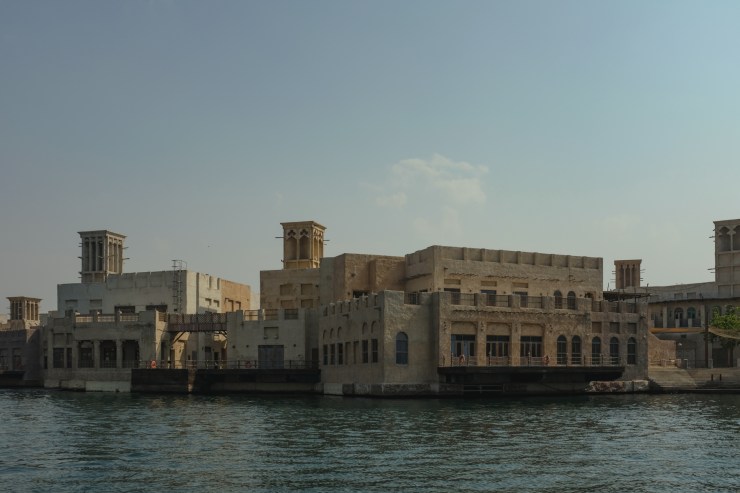
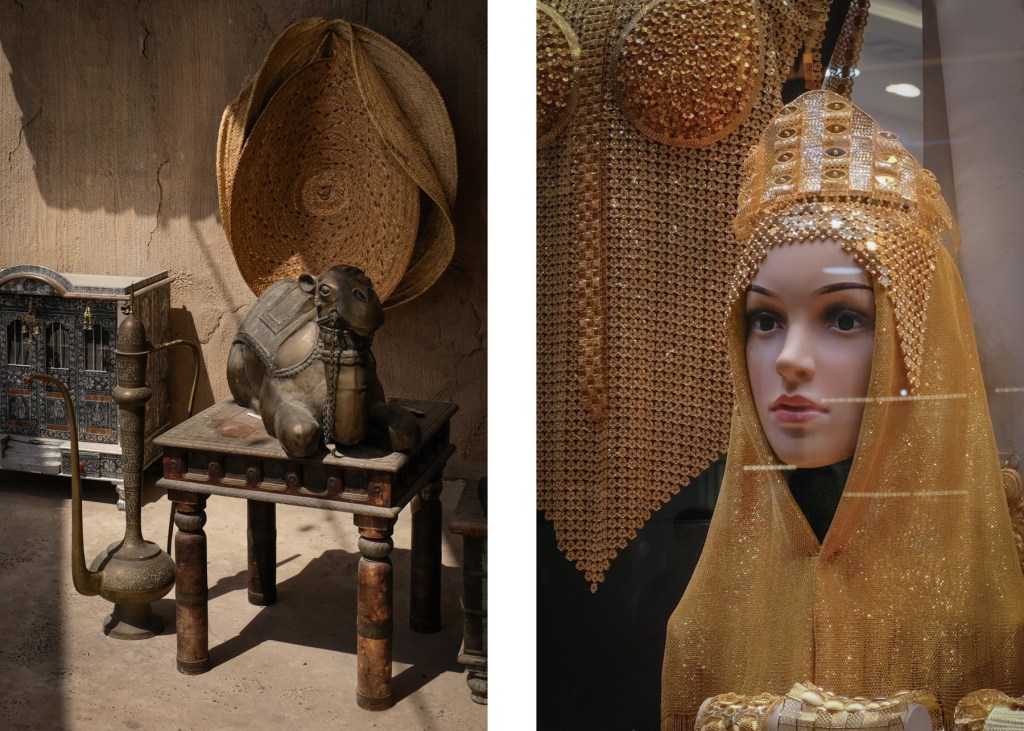
The oldest part of Dubai is centered around the Grand Souq. Known in Arabic as Al Souq al Kabir (السوق الكبير), literally “the big market,” it is divided into two halves by the Dubai Creek, a large saltwater artery around which trade and transport grew. Located in the southern half is Al Bastakiya. Also called the Al Fahidi Historical Neighborhood, the Bastakiya quarter preserves many features found in the pre-oil Persian Gulf. Nestling between the narrow alleyways, rectangular courtyards swirl with the green of climbing fig vines. During the broiling summers, when the Middle Eastern heat soars to record highs, sepia-toned barajeel (برجيل) wind towers draw cooling drafts down into the buildings. The area was built in the 1890s primarily by Persian merchants. Consequently, it shares its name with an Iranian town across the Gulf, Bastak. Its other alias, Al Fahidi, is connected to Dubai’s Al Fahidi Fort. Built in 1787 partially out of coral rock, the fort is the oldest standing structure in the city.


An abra (عبرة) with a scorched and faded red canopy ferries passengers across the Creek. The traditional wooden boat skims the surface of the water unhurriedly like a garden snail, leaving behind effervescent trails of white bubbles. At all hours of the day, there is an incessant procession of them. On the other side is Deira, where the northern half of the Grand Souq continues in a cacophonous sea of spices, textiles, and trinkets. Deira enjoyed its heyday during the prosperous era of pearling, although it continues to remain a major attraction. Steps away from the jetty are passageways that shimmer brighter than sunbeams. They reveal the genesis of Dubai’s other moniker: the City of Gold.
The Gold Souq of Deira has been in business since the 1900s. In more recent decades, it’s earned the emirate a solid reputation as a haven for “cheap gold.” The oxymoron refers not to the quality of the precious metal, but rather to the exclusion of taxes. Apart from a five percent value-added tax introduced in 2018—most of which can be refunded at the airport—there are no other taxes and customs levied on gold in the sheikhdom. Still, buying bling here is best done with a careful eye and a slick tongue. Gold in the souk is sold by karat and weight; like stocks, its price fluctuates on a daily basis. The rate du jour is displayed on signs around the marketplace, but the price on the labor that goes into a piece—its make—remains negotiable. Thus, as is the common practice in most bazaars, haggling is not out of the question, even for a commodity as valuable as gold.
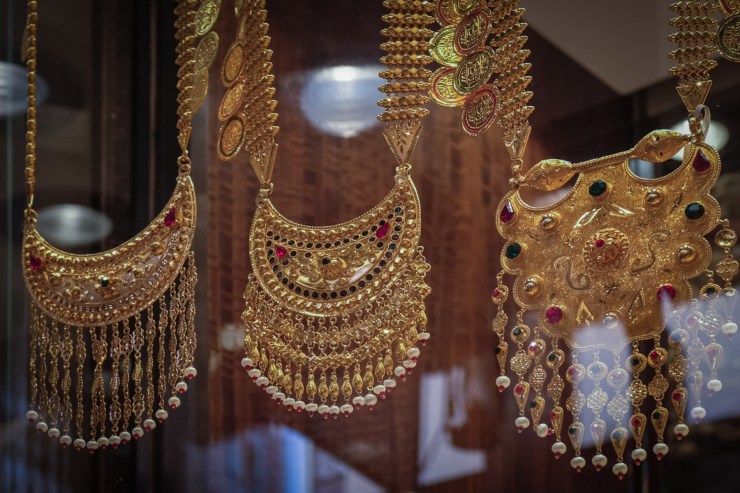
Every conceivable design can be found in the Gold Souq, luring treasure hunters from near and far to this old Dubai district. The wares range from timeless classics to pieces of unfettered extravagance and creativity. There are diamond-encrusted bangles and anklets, gauzy headdresses, and even chainmail made wholly of gold—enough fantasy to belong in the pages of one of Scheherazade’s tales. Some, like the crescent-shaped mariyyat umm shnaf (مرية ام شناف), are an essential part of local Emirati heritage. They belong to the dazza (دزة), a dowry of physical objects lavished upon the bride during the wedding period.
Dubai’s transformation from fishing village to luxury mecca of the Middle East did not come about haphazardly. Much of it is credited to the strategic planning of the emirate’s former ruler, Sheikh Rashid bin Saeed Al Maktoum. Although oil brought wealth into the region, Dubai’s reserves are dwarfish compared to Abu Dhabi’s and finite. Realizing this, Rashid prepared the city so that it would continue to flourish even after the end of oil production. Capitalizing on the UAE’s location at the crossroads of Africa, Asia, and Europe, the sheikh poured oil revenues into Dubai Creek, turning it from a tidal inlet into a state-of-the-art deepwater port. Money also went into building a world-class airport, which is now the world’s busiest in terms of international passenger traffic.
Beginning in the 1980s, the emirate loosened its financial and banking laws, siphoning business from Beirut. (The elegant French-influenced Lebanese capital, once regarded as the intellectual epicenter of the Middle East, saw its prosperity punctured by civil war.) The 1990s marked the dwindling of Dubai’s reliance on oil and the start of heavy investment in real estate. And more recently, the turn of the millennium ushered in a new season characterized by the blossoming of skyscrapers across the Dubai desert, concentrated namely around the man-made Dubai Marina, Sheikh Zayed Road, and Downtown Dubai. Today, Dubai has successfully transitioned into a post-oil economy, with oil accounting for less than one percent of the emirate’s gross domestic product.


As far as superlatives go, the city is never short on them, insofar that a mere day tour can feel like an interstellar voyage. In Downtown Dubai, the Burj Khalifa rests high above its competition as the tallest building on earth. At its foot is the labyrinthian Dubai Mall, the world’s largest mall in total area and home to a 10-million-liter aquarium housing more than 400 sharks and rays. On the other side of the city is the Palm Jumeirah, Dubai’s plume-shaped island and gated residence famously pulled out from the sea. From its roots sprouts the Aura Skypool, where flocks of social media stars with sculpted features and sandblasted skin can be found lounging around the world’s highest 360-degree infinity pool. At the crown of the Palm is the Atlantis resort complex. With underwater suites perennially lauded as one of world’s most unique accommodations, life under the sea is as luscious as it is expensive. As far as the eye can take in, there is nothing left to happenstance. Every detail of Dubai serves a purpose: to attract more attention, fuel more consumption, and generate more wealth.
It can feel impossible to pinpoint parts of Dubai that feels “authentic” in the traditional sense of the word, with many arguing that the city doesn’t have the history for it. Even local Emiratis are hard to find. At just over a tenth of the country’s population, their presence is nearly imperceptible. But having the entire world in a nutshell is not something that every metropolitan can boast. It takes a vision, and a willingness to make risks. Behind the veneer of its futuristic silhouette, the authenticity of Dubai lies in its audacity.


 Gregory Gioro